Moving your belongings into storage doesn’t need to be stressful. With the right preparation, you can make the process smoother, safer, and far more efficient. A little planning prevents damaged items, wasted space, and back-and-forth trips you didn’t need to make.
At U-Lock Self Storage, facilities are set up for real-world convenience: drive-up access, free trolleys, wide driveways for trucks and trailers, and 24/7 availability so you can move on your schedule. Use the steps below as your straightforward playbook from planning to organisation.
Plan Ahead Before You Move
Before any boxes are taped shut, spend a few minutes thinking through what’s going into storage and how it will be arranged. The goal: arrive once, load once, and lock up with confidence.
- Measure and estimate your storage needs.
Walk through your home or office and list larger items (sofas, mattresses, desks, appliances) plus the number of boxes you expect. Then use our Space Calculator to estimate the right unit size. Booking the right size the first time saves time, effort, and money. - Book early.
Peak periods—end of month, end of lease, and school holidays—fill quickly. Reserve your preferred unit and location in advance so you don’t have to compromise. - Visualise your layout.
Sketch a quick plan. Decide which items you’ll need access to in the next 1–3 months (seasonal clothes, sports gear, paperwork). Those should live near the front. Heavy items belong on the floor with lighter items stacked above.
Pack Smart and Protect Your Items
Good packing pays off twice: once on move-in day and again when you come back to find your items exactly as you left them. Start with quality supplies from the Box Shop: sturdy cartons, packing tape, bubble wrap, furniture covers, and marker pens.
Smart packing principles
- Match box sizes to contents – Use small, strong boxes for heavy items (books, tools). Reserve large boxes for light, bulky items (bedding, cushions).
- Wrap and cushion – Individually wrap fragile pieces. Fill voids inside boxes so contents can’t shift in transit.
- Disassemble where possible – Remove table legs, take shelves out of bookcases, and store hardware in labelled zip-bags taped to the item or placed in a clearly marked “fittings” box.
- Use hollow spaces – Pack pillows or linens inside drawers and suitcases. Nest smaller boxes inside sturdier ones if it helps stabilise stacks.
- Label clearly – Mark multiple sides with both room and contents (e.g., “Bedroom – Bedding & Lamps”). A simple master list on paper or in your phone helps too.
- Moisture and dust control – Use mattress and furniture covers, and avoid plastic wrap directly against wood or leather for long periods; breathable covers are best.
Pro tip: If something is valuable, sentimental, or urgently needed later, pack it in a dedicated, clearly marked box and plan to store it near the front of your unit.
Load Your Unit Strategically
This is where planning meets practice. The aim is a stable, accessible layout that uses all three dimensions: length, width, and height.
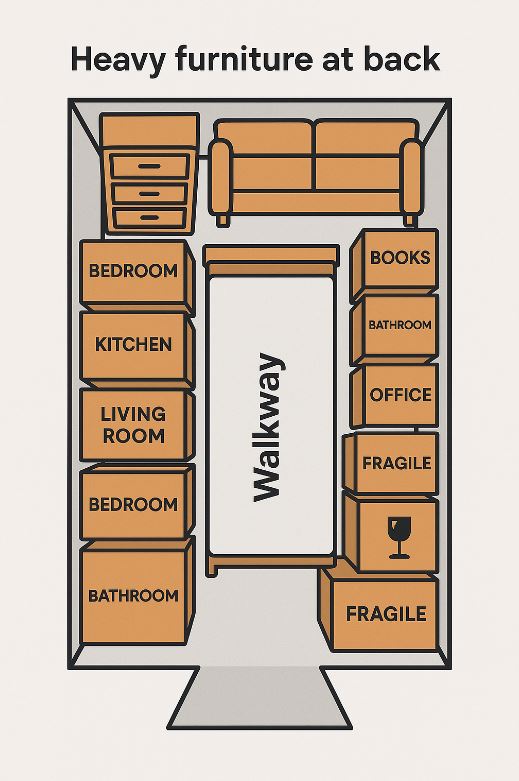
- Start from the back and bottom – Place the largest, heaviest items at the back of the unit and on the floor: appliances, wardrobes, bookcases. This creates a stable foundation for stacking.
- Build stable stacks – Stack boxes of similar sizes together to prevent leaning towers. Keep the heaviest cartons at the bottom of each stack.
- Leave a walkway – Even a narrow aisle down the centre saves time later. You’ll be able to reach anything without dismantling your entire setup.
- Use vertical space wisely – Install freestanding shelves if you’ll access items often; otherwise, stack to shoulder height where safe.
- Protect surfaces – Lay blankets or cardboard between wood furniture pieces to prevent scuffs. Cover sofas and mattresses with breathable covers.
- Stage “grab-and-go” items near the door – Sports gear, seasonal clothing tubs, frequently referenced files—anything you’ll want soon should be front and centre.
Make Move-In Day Easy
The best move-in days are boring—in the best way. Everything is ready, organised, and done in one go. A short checklist helps.
Move-in checklist
- Keep your identification and booking confirmation handy.
- Pack a small toolkit (screwdriver, hex keys, utility knife, tape).
- Bring straps or rope for stabilising loads on trolleys.
- Load the vehicle in reverse order of how you’ll unload (items for the back of the unit go in last, so they come out first).
- Wear closed-toe shoes and gloves for safer handling.
On arrival, take advantage of the site design: drive-up access to park right by your unit, free trolleys to save extra trips, and wide driveways that make turning large vehicles much easier. Moving in the evening? With 24/7 access, you can set your own pace and avoid the midday rush.
Tip for valuables and essentials: Keep passports, personal documents, medicines, and small electronics in a separate, clearly marked box you keep with you—or position it at the very front of your unit where you can easily access it at any time.

Keep It Organised for the Long Term
Storage is simplest when you can find what you need without a search party. Build in a few habits now to save time later.
- Group by season or use. Store summer gear together; do the same for winter items. Rotating is easy when like-items live side by side.
- Use stackable containers or shelving. Clear tubs make identification faster and protect against dust. Shelving helps if you access the unit frequently.
- Maintain a contents list. A simple spreadsheet or notes app works. Include box numbers, brief contents, and where each sits in the unit (e.g., “Left wall, mid-stack”).
- Check in periodically. Every couple of months, open the unit, let air circulate, and do a quick tidy. If you’re adding more items, purge or rearrange to keep the walkway clear.
- Update labels. If contents change, relabel immediately. Future-you will be grateful.
Common Mistakes to Avoid
A short list of “don’ts” can prevent the most frequent headaches.
- Overloading large boxes. They become unstable and difficult to lift.
- Skipping protection. Uncovered mattresses and couches attract dust; uncovered wood can scuff.
- Blocking the back. A solid wall of boxes with no walkway guarantees frustration later.
- Random labelling—or none at all. If you can’t identify a box in seconds, you’ll waste time every visit.
- Not booking the right size. Too small leads to cramped, risky stacks; too large means paying for air. Use the Space Calculator and call our team if you’re on the fence.
Supplies You’ll Be Glad You Had
A small kit of essentials radically speeds up move-in and protects your belongings.
- Double-walled moving boxes (small and medium)
- Packing tape and tape gun
- Bubble wrap and packing paper
- Mattress and furniture covers
- Marker pens and pre-printed labels
- Utility knife and scissors
- Zip-bags for fittings and cables
- Moving blankets or leftover cardboard sheets (for floor and furniture protection)
You can pick up everything on this list from the Box Shop, or order online ahead of time and collect on arrival.
Your Storage, Simplified
Getting organised before move-in day takes a little time but saves a lot of effort. Measure and book the right size, pack with protection in mind, and plan a stable layout that uses vertical space without sacrificing access. On the day, arrive with a simple checklist and lean on the practical design of U-Lock facilities—drive-up access, free trolleys, and 24/7 entry make all the difference.
If you treat your storage unit like a well-arranged room, you’ll move faster, find items easily, and keep everything in the same condition you stored it.
Ready to move in?
Book your unit online today or visit our Box Shop for quality packing supplies that make your move safe and simple. If you’re unsure about size, try the Space Calculator or contact your nearest facility via our Locations page for friendly advice.